Manus alternatives after Manus 2.0, and when to stay

Construct Team · Editorial team
The team building and documenting Construct Computer.
Published · @use_construct
On this page16 sections · 11 min read
The right Manus alternative depends on why you are leaving. If credits are the problem, look at a flat monthly plan such as Construct, or bring your own model key, which Manus itself now allows through Manus Flex. If you want recurring work on a schedule, Claude, Construct, Lindy and Perplexity Computer all run scheduled tasks, each with a different billing unit. If you mostly hand over one-off builds such as slides, sites, videos and apps, Manus 2.0 is still one of the strongest options, and Genspark is its closest like-for-like rival.
We make Construct, so read this page knowing that. Products below are in alphabetical order, every fact was checked against the vendor's own pages on October 26, 2026 unless marked otherwise, and there is a section on the jobs where Manus is the better pick.
What changed at Manus in 2026
Three things changed since most Manus comparisons were written.
Manus left Meta
Manus wrote that "On December 29, 2025, Meta acquired Manus", and on August 11, 2026 it told users that, as part of its separation from Meta, data generated by certain users from that date on would be deleted from 8:00 a.m. SGT on August 23, 2026 (A note to our users). Accounts created on or after December 29, 2025 lost their account, task and subscription data; older accounts lost tasks and connectors from that period (Manus Help Center). A post dated September 1 says "Manus has formally resumed independent operations", and its restoration portal has no deadline (Manus).
Manus 2.0 shipped on September 28
It added a Cloud Computer you buy separately, Automations that start from a schedule or from "a new email, a change in ad performance, a calendar event, a Slack message, or a Notion update", Manus Studio as a desktop workspace, and Computer Use, where Manus works "in its own visible workspace on your computer" (Introducing Manus 2.0). The same post introduced Cue, a separate app where "each agent has its own email, phone number, wallet, and computer"; it is in early access by invite code.
Manus Flex lets you bring your own key
Since September 29, you can power Manus with your own API key through OpenRouter, Fireworks or Modal, although "other services and infrastructure used as part of a Manus task still consume Manus credits" (Introducing Manus Flex). Older comparisons say Manus chooses the model for you, which is no longer true.
What Manus costs now
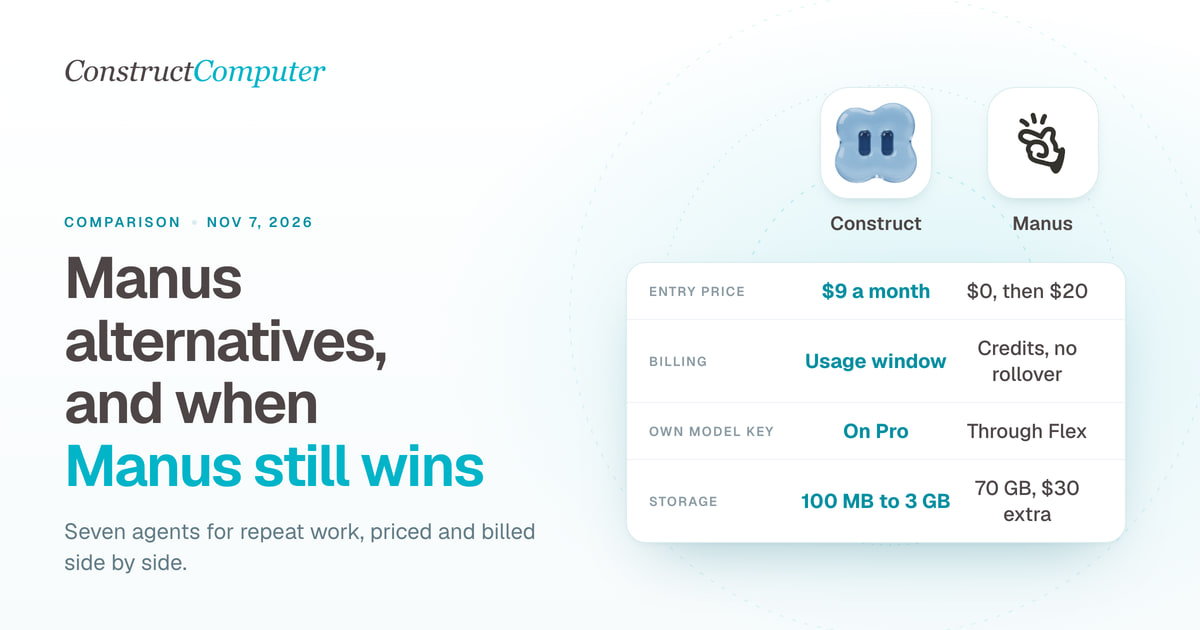
| Free | $0 | 300 credits a day, 1 task at a time, 2 scheduled automations |
| Pro | $20 | 4,000 credits a month, 20 concurrent tasks, 20 scheduled automations |
| Pro, higher tier | $40 | 8,000 credits a month, same limits, 7-day free trial |
| Team | From $20 a seat | Pro features, 4,000 credits per seat pooled across the team |
| Cloud Computer | $30 or $50 extra | 2 vCPUs with 4 GB or 8 GB of RAM, 70 GB or 120 GB of storage |
Annual billing takes 17% off (membership pricing, Manus Team, Cloud Computer billing).
Credits are spent on model tokens, virtual machines and third-party APIs while a task runs. "Manus does not allow unused credits to roll over to the next cycle", daily free credits work only with Manus 2.0 lite, and you cannot start a new task at or below zero (credit rules). If a Cloud Computer subscription lapses, "the persistent virtual machine will be shut down" and its working files, installed tools and databases are deleted; outputs delivered in chat stay in your history.
Credits are also where the complaints are. Manus has a 1.2 out of 5 TrustScore from 209 Trustpilot reviews, 94% of them one-star, checked October 26, 2026. One reviewer, writing on October 6, upgraded for more credits and says "When the next billing cycle started, 31,132 unused credits expired"; another, on September 3, says "Upgrading your tier on Manus AI is instant, but downgrading is practically impossible" (Trustpilot). Trustpilot reviews skew toward unhappy customers, so read these as the shape of the risk rather than a measure of it.
Methodology
We included products that do multi-step work with tools on a computer the agent controls, that a small team can buy without a sales call, and that people searching for Manus alternatives are likely to weigh. We checked each vendor's pricing page and help center on October 26, 2026. OpenAI's and Genspark's pages blocked our fetches, so their rows rely on the reporting we name. This page compares documented features and published prices; it is not a hands-on benchmark, and none of the products is ranked.
Manus alternatives at a glance
| ChatGPT Dots | $100 (Pro 100) or Business Premium | Plan allowance after the first month | Always-on agent in ChatGPT, Slack and Teams | OpenAI models only |
| Claude | $20 (Pro) | Rolling 5-hour window plus weekly cap | Hourly, daily, weekly or weekday tasks | Claude models only |
| Construct | $9 (Lite) | 4-hour window plus monthly allowance | 3, 10 or 50 Calendar schedules by plan | Yes, on Pro |
| Genspark Claw | $24.99 (Plus) plus a Cloud Computer | Credits | Scheduled tasks | Not documented |
| Lindy | $29.99 per active user | Credits pooled across users | Routines on a schedule or an event | Not documented |
| OpenClaw (self-host) | $0 software plus server and tokens | Your provider's token bill | Scheduled jobs you configure | Yes, required |
| Perplexity Computer | Pro, or Max at $200 | Credits, 100 credits = $1 | Scheduled tasks, at most hourly | Not documented |
| Manus, for reference | $0 (Free) or $20 (Pro) | Credits, no rollover | Schedules and triggers from connected apps | Yes, through Flex |
"Entry price" is the cheapest way in, not a budget for a busy month. Our guide to what an AI agent costs per month works through what each billing unit means once the work gets heavy.
ChatGPT Dots
OpenAI launched Dots on September 29, 2026: always-on agents inside ChatGPT, each with its own cloud computer, reachable from ChatGPT, Slack and Teams. It is rolling out to ChatGPT Pro and Business Premium, and Pro subscribers in the EEA, Switzerland and the UK are not included. Actions that touch your accounts pass an automatic review, and usage did not count against plan allowances for the first month (SiliconANGLE). Pro now comes in three tiers at $100, $200 and $500 a month, each with one dot (Codersera's summary of the DevDay announcements). OpenAI's own pages blocked our fetch, so these rows rest on that reporting.
It fits if you already pay for ChatGPT Pro outside Europe and want one personal agent. Our ChatGPT Dots alternatives page covers it in depth.
Claude
Claude Cowork and chat merged into one Claude on September 16, 2026, and by default Claude "asks before taking an action" (Anthropic). Scheduled tasks are available on every paid plan, run hourly, daily, weekly or on weekdays, and keep running "even when your computer is asleep or the Claude Desktop app is closed", although tasks that need local files run only on your machine (Claude Help Center). Pro is $20 a month, or $17 billed annually, and Max starts at $100; usage resets on a rolling five-hour window with weekly limits on top (Claude pricing).
Pick it if you already live in Claude and want personal recurring jobs without another bill. Construct vs Claude Cowork compares the two in detail.
Construct
Each Construct agent works from a persistent cloud workspace with files, a browser, a terminal, its own email address and a Calendar of scheduled jobs, and you can reach it from the web, Slack, Telegram, Discord or email. Plans are Lite at $9 a month (2 agents, 3 scheduled tasks), Starter at $59 (5 agents, 10 scheduled tasks) and Pro at $299 (15 agents, 50 scheduled tasks, your own keys for OpenRouter, OpenAI, Anthropic, Amazon Bedrock or xAI) (pricing). Teams share a workspace with no seat limit on any plan.
Instead of credits, usage is metered in two windows: a four-hour window and a monthly allowance, both resetting on the clock. Like Manus credits, unused monthly usage does not carry over. What differs is that a team pays one plan price, and a Pro owner can set the agents to fall back to their own model keys when Construct's included usage runs out. You can read, correct or forget anything the agent remembers in the Memories app.
Two limits matter for anyone coming from Manus. Construct's computer sleeps when idle and terminal commands time out after five minutes, so it cannot host a bot or server that runs all day the way a Manus Cloud Computer can. And workspace storage is 100 MB on Lite, 1 GB on Starter and 3 GB on Pro, far below the Cloud Computer's 70 GB.
Choose it when your work repeats on a schedule, several people need the same files and history, and you want one predictable bill. How to run an AI agent on a schedule shows the setup.
Genspark Claw
Genspark is the closest like-for-like rival to Manus for one-off builds. Its pricing pages blocked our fetch; a third-party guide updated October 15, 2026 lists Plus at $24.99 a month for 10,000 credits and Pro at $249.99 for 125,000, says Claw needs a separate Cloud Computer subscription, and warns that "cancelling the Cloud Computer permanently erases the data stored on it" (MyClaw). We could not confirm the Cloud Computer price on a current page. Construct vs Genspark Claw has more.
Worth a look if you want Manus-style deliverables from a different vendor and are comfortable with a second credit system.
Lindy
Lindy's Team plan is $29.99 a month for 3,000 credits per active user, "Every active user in your workspace is billed", credits are pooled and "don't roll over", and top-ups are $10 per 1,000 credits. The free plan gives $50 in credits that "last 7 days" (Lindy pricing). Its reviews carry the same credit complaint as Manus: one Trustpilot reviewer wrote in August, "I managed to kill my months credits (3000) in one day!" (Trustpilot).
It suits work that runs through each person's inbox, meetings and Slack, for a team happy to pay per user. See Lindy alternatives.
OpenClaw, self-hosted
OpenClaw is open source, and version 2.0 shipped on August 30, 2026 (OpenClaw). You pay for the server and the model tokens, and you own the security. Its own docs say "Sandboxing is off by default" and that out of the box "exec runs on the gateway host without prompts" (OpenClaw docs), so a fresh install needs hardening before it touches business accounts.
Go this way if you want full control of the model, the data and the bill, and someone on the team can run a server. Hosted OpenClaw alternatives covers managed hosts.
Perplexity Computer
Perplexity says "Computer credits are available to Pro and Max subscribers", that paid consumer Pro plans now include a weekly amount of Computer usage (rolling out gradually), and that Max starts with 10,000 credits a month at "100 credits equals $1". Its own examples put a quick fact at 15 to 70 credits, a research report at 350 to 950, a data dashboard at 2,400 to 9,800, and an app or multi-day build at 15,000 or more (how credits work). Another of its help pages still says Pro includes no monthly credits, so check your own account. Max costs $200 a month (Perplexity Max). Scheduled tasks run at most hourly; a run is skipped when credits run out, and after repeated skips the task pauses and stays paused (Perplexity Tasks).
Use it for research-heavy jobs with cited sources, if you can live with credit pricing that resembles Manus's.
When Manus is the better pick
Stay with Manus, or keep it alongside something else, when the work looks like one of these:
- One-off builds such as websites with custom domains, slide decks, video edits and small games. That is what Manus is built around, and 2.0 added dedicated Video Editor and Game Dev environments.
- Jobs that must start from an event in another app. Manus Automations fire on a new email, a change in ad performance, a calendar event, a Slack message or a Notion update, while most alternatives here run on a clock.
- Something that must run all day. A Cloud Computer keeps a bot, scraper or server running 24/7 with up to 120 GB of storage.
- An agent that needs its own phone number or wallet, which only Cue offers, in invite-only early access.
- Occasional small tasks for free, which the 300 daily credits on the free plan cover.
- Work on your own machine, where Computer Use runs in a visible workspace with access only to what you approve.
If credits are your only complaint, try Manus Flex with your own key before you move, and keep the credit math in mind: infrastructure still draws on Manus credits.
Moving one job off Manus
You do not have to cancel Manus to test an alternative. Move the one recurring job where credits or lost files hurt most, and keep Manus for builds.
- Download the outputs you want to keep. Nothing transfers between products, and a lapsed Cloud Computer deletes its working files.
- Copy the Automation's prompt and write your standing rules into the first message on the new product.
- Upload last week's output, so the next run can compare against it.
- Run the job by hand twice and check both results before you put it on a schedule.
- Keep anything that sends or publishes as a draft until it has run cleanly a few times.
Move one recurring job to Construct
How we checked this
Manus facts come from manus.im and help.manus.im, read on October 26, 2026: the August 11 and September 1 posts on the Meta separation, the August 21 service-change article, the Manus 2.0 and Manus Flex posts, the Team page, and the help-center articles on membership pricing (marked "updated this week" when we read it), credit rules and Cloud Computer billing (updated September 23). We did not find a help article describing a memory you can view and edit, so we make no claim about Manus memory either way. Construct's plan limits, usage windows, storage, command timeout and seat rules were checked in Construct's source code on the same day.
Sources
- Manus: A note to our users, Manus resumes independent operations, Service change overview, Introducing Manus 2.0, Introducing Manus Flex, Manus Team
- Manus Help Center: membership pricing, credit rules, Cloud Computer billing
- Trustpilot: Manus and Trustpilot: Lindy
- SiliconANGLE on ChatGPT Dots, September 29, 2026 and Codersera on the ChatGPT Pro tiers, September 30, 2026
- Claude: Cowork is now Claude, pricing, scheduled tasks
- MyClaw: Genspark pricing, October 15, 2026
- Lindy pricing
- OpenClaw: 2.0 release post, the trust boundary
- Perplexity: how credits work, Perplexity Max, scheduled tasks
- Construct pricing
Related resources
- How much does an AI agent cost per month?
- How to run an AI agent on a schedule with your laptop closed
- AI agent prompt injection
- Construct vs Genspark Claw
- Hosted OpenClaw alternatives
- AI employees for small business: 10 platforms compared
Frequently asked questions
- Is Manus still owned by Meta?
- No. Manus says Meta acquired it on December 29, 2025. As part of the separation it deleted some users' data from August 23, 2026, and a Manus post dated September 1, 2026 says it has formally resumed independent operations.
- Can you use your own API key with Manus?
- Yes. Manus Flex, launched September 29, 2026, lets you power Manus with your own key through OpenRouter, Fireworks or Modal. Other services and infrastructure used in a task still consume Manus credits.
- Do Manus credits roll over?
- Monthly plan credits do not. They are cleared on the renewal date, even if you upgraded mid-cycle. Add-on credits carry over as long as you keep an active paid subscription.
- What happens to a Manus Cloud Computer if you stop paying?
- Manus shuts the virtual machine down and deletes its working files, installed tools and databases. Outputs that were delivered in chat stay in your chat history, so download anything else before you cancel.
Keep reading

AI Agent vs Virtual Assistant: Cost and Capabilities
AI agent vs virtual assistant: compare monthly cost, availability, and inspectable work records before you replace suitable VA tasks with a supervised AI employee.
- ai-agent
- virtual-assistant
- pricing
- comparison
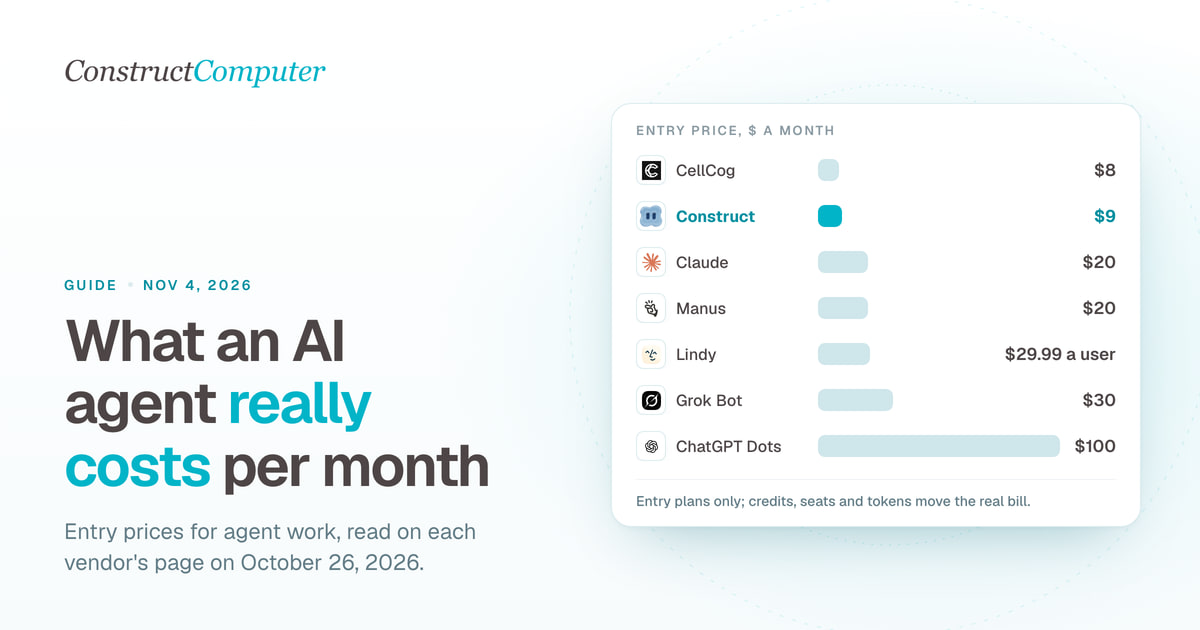
How much does an AI agent cost per month?
AI agent pricing compared: credit plans from $8, big-lab subscriptions from $20 to $500, and self-hosting with a server plus tokens, with every plan's cap explained.
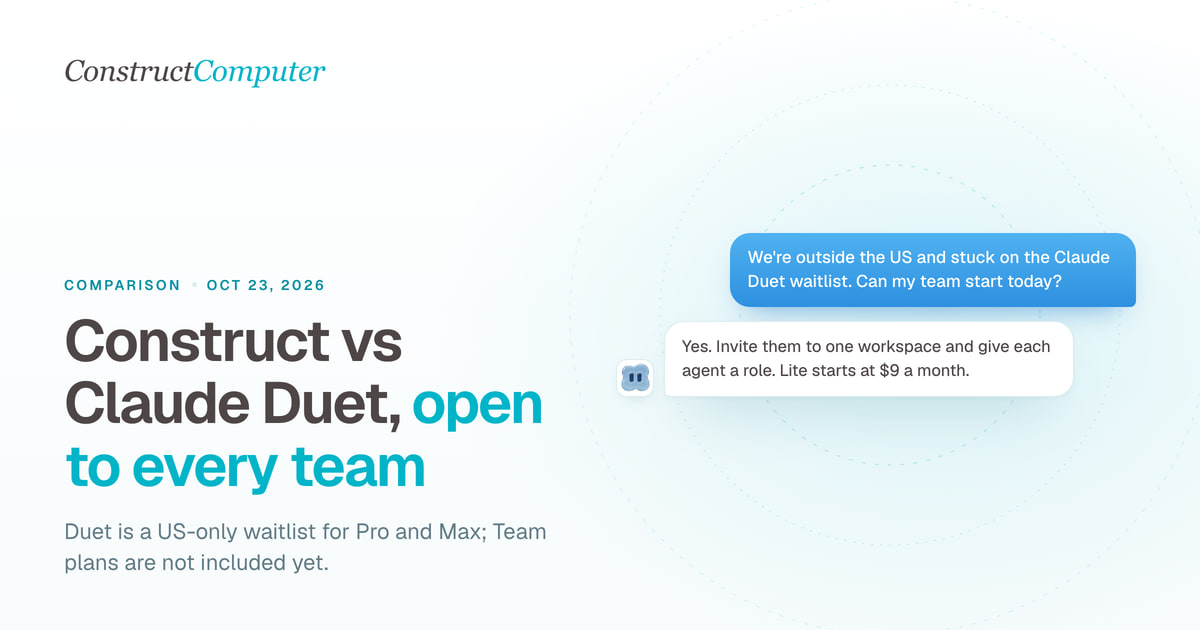
Construct vs Claude Duet
Claude Duet is one agent for one US subscriber, behind a waitlist. Construct gives your team a workspace of agents from $9 a month, available today, anywhere.

