AI Agent vs Virtual Assistant: Cost and Capabilities

Ankush · Author
Writes about Construct, AI agents, and developer tools.
Published · Updated · @ankushKun_
- ai-agent
- virtual-assistant
- pricing
- comparison

On this page7 sections · 7 min read
Construct gives you an AI employee that reviews an inbox, updates your CRM, and runs scheduled research around the clock from $9 a month, with its own email address and 3 scheduled tasks on Lite. A part-time human virtual assistant covering daily email and calendar typically costs $1,000 to $3,000 a month, and even a managed offshore hire runs $640 to $2,400 a month full-time (tendem.ai; cherryassistant.com).
For founders and small teams, Construct is the better first hire for recurring, cross-app work. It costs a small fraction of a VA, starts the same day instead of after weeks of onboarding, keeps a record of what it did, and leaves every finished file in your workspace. If you already have a VA you trust, keep them for relationship work and give Construct the repeatable execution around it.
Why choose Construct over hiring a VA for this work?
- $9 a month instead of $1,000 or more. Lite includes 2 agents, 50 steps per task, 3 scheduled tasks, and an agent email address. Even Pro at $299 costs less than the low end of a full-time VA.
- Works while you sleep. Calendar schedules run server-side with your laptop closed, so the Monday report is ready on Monday morning.
- No onboarding curve or turnover. Construct saves your preferences as memory you can read and correct, so nothing is lost when someone leaves.
- A record of every job. Activity records each action with a short reason, and the resulting files and sent messages stay in the workspace.
- Finished work you can open. Reports, spreadsheets, and drafts are saved to workspace files as the agent produces them.
- Reachable where you already are. Message it from the web app, Slack, Telegram, or Discord, or email its own inbox.
Cost comparison: monthly VA spend vs Construct
What Construct costs
Construct's published plans, current as of this update and subject to change:
| Plan | Price | Agents | Steps per task | Scheduled tasks | Parallel background jobs | Notable |
|---|---|---|---|---|---|---|
| Lite | $9/month | 2 | 50 | 3 | 2 | Agent email address |
| Starter | $59/month | 5 | 150 | 10 | 4 | 6x Lite usage, agent email |
| Pro | $299/month | 15 | 1,000 | 50 | 8 | 32x Lite usage, model BYOK |
Even the Pro plan, built for heavy recurring workloads, costs less than the low end of a single full-time human VA's monthly rate. Pro has a 7-day free trial. Check current plans before budgeting, since commercial terms can change.
What a human VA costs in 2026
Human VA pricing varies by where the person is based and how the engagement is structured. Hourly rates run $5 to $75 depending on location and skill level, and a part-time arrangement covering daily email and calendar management typically runs $1,000 to $3,000 a month, according to Tendem's breakdown of virtual assistant costs (source: tendem.ai).
Full-time engagements show a wide domestic-versus-offshore split. Cherry Assistant puts an offshore managed agency at $640 to $2,400 a month full-time, against $4,700 to $8,300 a month as the realistic total cost of a US-based in-house assistant once salary, benefits, payroll taxes, and recruiting are included (source: cherryassistant.com). Stealth Agents' research on Filipino VA agencies lands in a similar range: $700 to $2,500 a month all-in for a managed agency hire, versus $4,800 to $12,000 a month for a comparable US-based hire (source: stealthagents.com).
Two more numbers matter beyond the sticker price. A structured offshore executive VA onboarding typically reaches full productivity between day 14 and day 30, and a rushed one can take 60 to 90 days or end in early turnover (source: outsourcedscale.com). Once someone is up to speed, outsourced VA teams still see about 18% annual turnover, and each replacement costs an estimated $3,600 to $5,400 in lost productivity and rehiring (source: 365outsource.com).
Where the gap comes from
Customer-service benchmarks illustrate part of the structural cost difference. The cited analysis estimates a routine AI-handled customer interaction at under $0.50, against $4 to $8 for a human agent (source: stealthagents.com). Those figures are for customer service, not every VA task, but they show why narrow, repeatable work is where an AI employee pays for itself first.

What a VA does, and what Construct does instead
A human virtual assistant handles inbox triage, calendar management, data entry, light research, travel booking, and client communication, applying judgment to a known playbook.
Construct takes on the repeatable parts of that list and executes them directly inside your tools instead of describing the steps back to you. For a scheduled inbox-review job, it can read and search its own inbox, draft or send replies, and flag uncertain cases for your decision. Connected Gmail actions add organization features when available. It researches the web, updates connected apps such as your CRM, and saves the results as files. If the term is new, what is an AI employee covers the concept in full.
Silent product demo: Construct organizing work across emails, files, and a CRM.
This is different from a plain chat assistant. A tool that only answers questions in a chat window is not doing a VA's job, no matter how good the answers are; see chat assistants vs AI employees. And if the work is a fixed sequence of triggers and actions with no judgment at all, Construct vs Zapier explains where each model fits.
Why inspectable work beats a chat-based "AI VA"
A chatbot that drafts a reply for you to copy and send does not itself record what happened in your inbox, calendar, or CRM. Construct does. Activity records each action with a short reason, chat keeps the tool records, and the resulting files and messages stay in the workspace, so you can check a week of delegated work in minutes. Activity covers a limited window and is an operating record rather than a complete audit log, so save anything you need to keep long term as a file.
Construct's memory also carries your preferences from one job to the next, and you can read, correct, or forget any stored fact; see AI agent memory for how it works. Memory learns from conversations and public web research, so add anything learned from a private file or app explicitly when a future job depends on it.
The category is young, and the right way in is one bounded, recurring job. McKinsey's 2025 State of AI survey found that no more than 10% of organizations report scaling agentic AI within any single business function, while 23% are actively scaling in at least one function and 39% are still experimenting (source: forbes.com). A small team that hands Construct its weekly inbox review or CRM update today is ahead of most of that curve.
Already using a VA? Add Construct in 15 minutes
You do not have to choose. Start by moving the most repetitive item on your VA's task list, so their hours go to the work that needs a person.
- Start on Lite for $9, or take the 7-day Pro trial for longer runs and more scheduled tasks.
- Copy your VA's written instructions for that task into a Construct chat, and upload any templates or lists to the workspace.
- Connect the apps the task touches, such as Gmail, Google Calendar, or your CRM, from the integration catalog.
- Run it once and check the result in Files and Activity.
- Put it on the Calendar so it runs every week whether or not anyone is online.
There is no import from a task list or a VA's notes: write the rules into the first instruction and Construct saves them as memory you can read. Construct's workflows do not pause for approval yet, so for anything client-facing, ask for drafts and have you or your VA send them once checked.
When might a human VA still fit?
- Customer-facing conversations that turn on tone or empathy. In the cited analysis, 93.4% of US consumers say they prefer a human for customer service work, and human-handled interactions scored 88% satisfaction against 60% for AI-handled ones (source: stealthagents.com).
- Relationship work where the other party wants a person: high-stakes client calls, sensitive HR conversations, negotiations.
- Anything in the physical world, such as in-person coordination. As Oana Manolache, founder and CEO of Sequel.io, put it about the evolving assistant role: "it doesn't replace what an executive assistant does now as the role has evolved" (source: fortune.com).
For the recurring, cross-app work that fills most of a VA's week, inbox review, CRM updates, scheduled research, and status reports, Construct is faster, cheaper, and leaves a record.
Which should you choose?
Choose Construct for the recurring work. It costs $9 a month instead of $1,000 or more, runs on a schedule with your laptop closed, keeps a record of each action, and never needs re-onboarding. If you have a VA for client relationships, keep them for that and let Construct run the execution around it.
Pick the task you would hand a new VA in their first week, such as a Monday inbox review or a weekly CRM clean-up, and give it to Construct with the same written instructions. Check the saved result, then put it on the Calendar. Start on Lite at $9, or try Pro free for seven days. To compare the execution model with a chat assistant, read Construct vs ChatGPT.
Frequently asked questions
- Is Construct a good alternative to hiring a virtual assistant?
- For recurring, cross-app work such as inbox review, CRM updates, scheduled research, and status reports, yes. Construct starts at $9 a month with its own email address and 3 scheduled tasks, runs with your laptop closed, and keeps a record of each action, while a part-time VA typically costs $1,000 to $3,000 a month.
- Can I use Construct alongside my VA?
- Yes. Move the most repetitive item on your VA's task list to Construct: copy their written instructions into a chat, connect the apps, run it once, and put it on the Calendar. Your VA's hours then go to client relationships and judgment calls.
- How does the monthly cost compare?
- Construct Lite is $9 a month, Starter $59, and Pro $299. The cited sources put a part-time VA at $1,000 to $3,000 a month, a full-time offshore agency hire at $640 to $2,400, and a US-based in-house assistant at $4,700 to $8,300 once benefits and recruiting are included.
- How do I verify the work was done correctly?
- Construct's Activity feed records each action with a short reason, chat keeps the tool records, and the resulting files and sent messages stay in the workspace. Activity covers a limited window and is an operating record rather than a complete audit log, so save anything you need long term as a file.
- When does a human VA still make sense?
- For customer-facing conversations that turn on tone or empathy, relationship work such as high-stakes client calls or negotiations, and anything in the physical world. For the recurring execution around that work, Construct is faster and cheaper.
Keep reading

AI Agent vs Zapier Automation
Zapier runs a fixed trigger-action recipe. See how an AI agent plans its own steps instead, with a side-by-side of the same recurring workflow built both ways.
- comparison
- zapier
- ai-agent
- automation
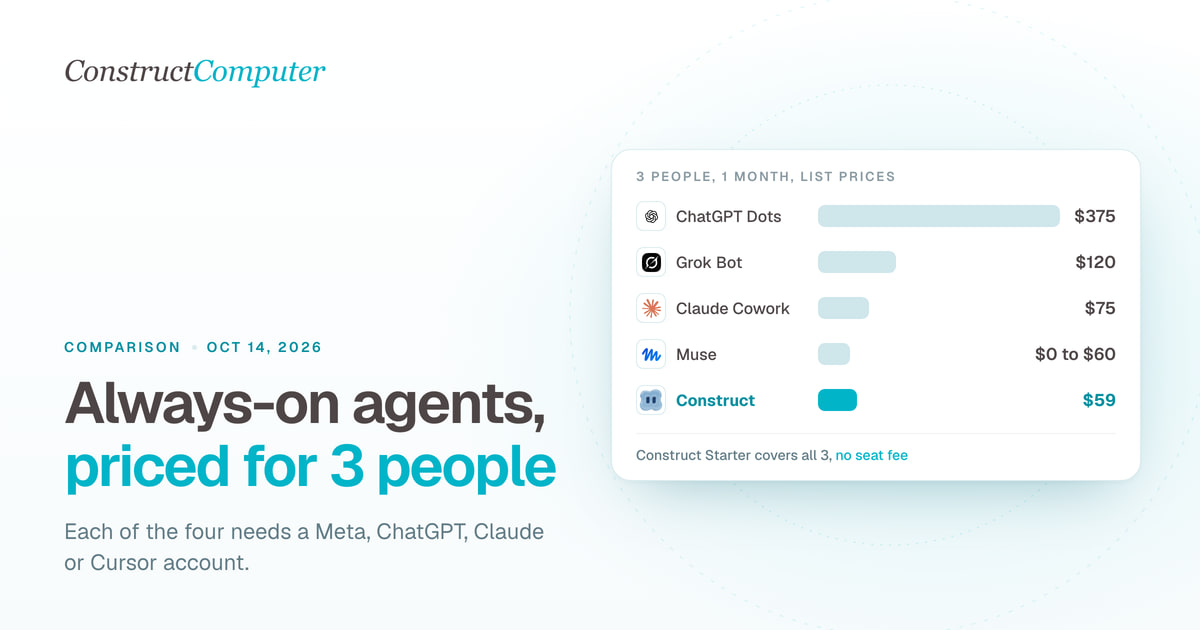
Dots vs Muse vs Grok Bot vs Claude Cowork for a small business
Always-on AI agents for a 3-person team cost $0 to $375 a month. Dots, Muse, Grok Bot and Claude Cowork compared on price, regions and approvals.

ChatGPT Dots alternatives: 9 always-on agents that don't need ChatGPT Pro
ChatGPT Dots needs a Pro or Business Premium plan. Compare 9 always-on agent alternatives from $0 to $50 a month, and which subscription each one needs.

What is an AI agent with its own computer?
An AI agent with its own computer keeps working in a cloud workspace after you close your laptop. How it works, the risks, and who offers one, from $9 a month.
- ai-agent
- always-on-agent
- ai-employee
- product

