
How much does an AI agent cost per month?
An AI agent costs $8 to $200 a month on a plan, or a server plus tokens if you run your own. Prices checked November 13, 2026, with the math.
 Nischal Naik
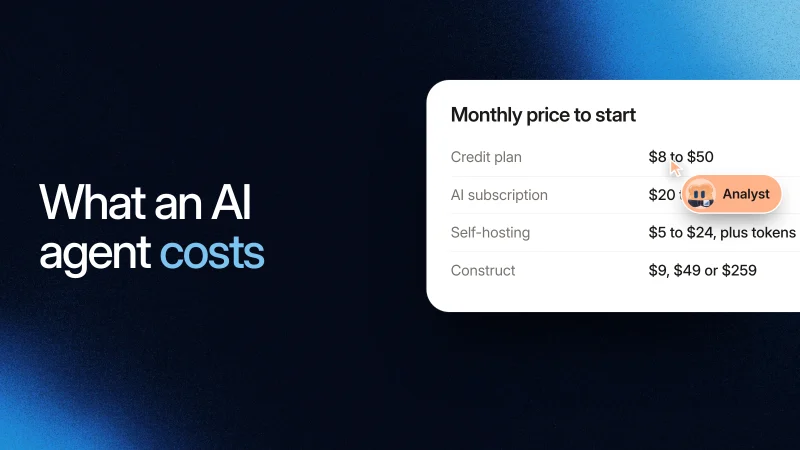
An AI agent that does real work costs $8 to $200 a month on a subscription, or a $5 to $24 server plus model tokens if you run one yourself. Credit plans such as CellCog, Lindy, Manus and Viktor start between $8 and $50 a month; Claude, ChatGPT, Gemini and Grok put agent features inside personal plans from $20 to $200; and a self-hosted agent pays per token, which for a 30-step research task comes to about 9 cents on Claude Haiku 5.5 and $3.48 on Claude Opus 5.5 at list prices. The price on the page matters less than the cap behind it, because the cap decides what a busy month costs.
We make Construct, which sells AI agents on monthly plans from $9, so it’s one row in the first table and has its own section below. Every other price was read on the vendor’s own page on November 13, 2026.
What are the ways to pay for an AI agent?
| How you pay | Monthly price to start | What runs out | Who it suits |
|---|---|---|---|
| A credit plan | $8 to $50, some per user | Credits, which most vendors reset each cycle | People who want a product and can live with a bill that varies |
| An agent inside an AI subscription | $20 to $200 per person | An allowance shared with your everyday chat | People already paying for that assistant |
| Self-hosting | $5 to $24 for a server, plus tokens and your time | Your token budget and your hours | Someone who can run and secure a server |
| Construct | $9, $49 or $259 per workspace | A monthly allowance | Small teams with recurring work |
What do credit-based agent plans cost?
A credit is a vendor’s own unit of work, and each vendor turns a task into credits differently. Compare what one of your jobs uses, not the number of credits on the plan.
| Product | Cheapest paid plan | Credits included | Unused credits | Free start |
|---|---|---|---|---|
| CellCog | $8 a month, or $88 a year (Starter) | 800 a month | Usable for the billing period and 60 days after | Not in its billing guide |
| Lindy | $49.99 a month per active user (Team) | 5,000 per user, in one shared pool | Reset each cycle; top-ups stay until used | $50 in credits for 7 days |
| Manus | From $20 a month (Pro) | From 4,000 a month | Not on its pricing page | 300 credits a day |
| Viktor | $50 a month (Team) | 20,000, shared by the workspace | Roll over for one month | Up to $100 in credits that never expire |
The fine print is where the cost moves. Lindy bills “every active user in your workspace,” from $49.99 a month for 5,000 credits each, and sells top-ups at $10 per 1,000 credits (Lindy pricing). Viktor is the only one that turns credits into jobs: it puts a quick task at 100 to 300 credits and a complex workflow at 500 to 1,500, so its $100 tier of 40,000 credits covers roughly 26 to 80 complex workflows a month (Viktor pricing). CellCog’s billing guide says “All payments to CellCog are final and non-refundable” (CellCog billing guide). Manus lists Pro “starting from $20/month” for 4,000 credits, and $40 for 8,000, with 17% off for a year (Manus pricing).
Before you buy one, run a job you would really hand over on its free tier and read the meter. One run tells you more than the plan table does.
Which AI subscriptions include an agent?
ChatGPT, Claude, Gemini and Grok each sell agent features as part of a personal subscription. The agent draws on the same allowance as your chat.
| Plan | Monthly price | Agent features | How usage is capped |
|---|---|---|---|
| ChatGPT Go and Plus | Not shown to our fetch | Scheduled tasks | Limits described in words |
| ChatGPT Pro | Not shown to our fetch | “Dot, your always-on agent”, scheduled tasks | Three usage tiers |
| Claude Pro | $20, or $17 a month billed yearly | “Hand off and schedule tasks” | Limits every 5 hours and every week |
| Claude Max | $100 | The same, with 5x Pro’s usage | The same windows |
| Claude Ultra | $200 | The same, with 10x Pro’s usage a week | No 5-hour limit for verified accounts |
| Google AI Ultra | From $99.99 | “First access” to Tasks in Gemini, in some countries | 20x AI Pro’s limits on the $199.99 tier |
| X Premium | $30 | Grok Bot | 4x Plus usage |
| X Super and Ultra | $100 and $200 | Grok Bot | 15x and 50x Plus usage |
Claude’s prices are on claude.com/pricing, and its help center says scheduled tasks “run remotely, so they run on their cadence even when your computer is asleep,” unless a task needs local files or apps, and repeat at most hourly (Claude Help Center). xAI’s page says “Plus does not include Grok Bot,” which makes Premium at $30 the cheapest way in (X Subscription pricing). Google lists Tasks in Gemini only under Ultra (Google AI plans). OpenAI’s pricing page named the plans and what each includes but showed no dollar amounts to our fetch, and its other pages refused automated reads, so the ChatGPT rows carry no prices.
These plans are good value if you already pay for the assistant. Each is bought per person, and the agent spends the same allowance as your everyday chat, so a heavy week of chatting leaves less for the agent.
What does it cost to run your own agent?
Open-source agents such as OpenClaw are free to download, so the bill has three parts: a server, the model’s tokens and the hours you spend.
The server is the cheap part. DigitalOcean’s Basic droplet with 2 vCPUs and 4 GiB of memory is $24 a month, and one with 1 vCPU and 2 GiB is $12 (DigitalOcean). Hetzner lists shared cloud servers from €5.49 a month before VAT, though its shared plans were marked “Currently not available” when we checked (Hetzner).
Tokens are where the range is widest, because an agent sends the whole growing conversation back to the model at every step. Take a 30-step research task that averages 25,000 input tokens and 800 output tokens a step: 750,000 tokens in and 24,000 out. Those are round numbers for the arithmetic, not a measured run.
| Model | Price per million tokens, in / out | One task | One task every weekday (22 a month) |
|---|---|---|---|
| Claude Haiku 5.5 | $0.10 / $0.50 | $0.09 | $1.91 |
| DeepSeek V4.1 Flash, off peak | $0.15 / $0.60 | $0.13 | $2.79 |
| Gemini 3.8 Flash, until December 31 | $0.75 / $3.75 | $0.65 | $14.36 |
| Gemini 3.8 Flash, from January 1, 2027 | $1.50 / $7.50 | $1.31 | $28.71 |
| GPT-6.1 Sol | $2 / $10 | $1.74 | $38.28 |
| Claude Sonnet 5.5 | $2 / $10 | $1.74 | $38.28 |
| Claude Opus 5.5 | $4 / $20 | $3.48 | $76.56 |
| Claude Fable 5.2 | $8 / $40 | $6.96 | $153.12 |
Prices are from Anthropic, DeepSeek, Google and OpenAI. Haiku 5.5’s price is for prompts up to 100,000 tokens, and DeepSeek charges twice its off-peak price from 01:00 to 04:00 and 06:00 to 10:00 UTC on weekdays.
Prompt caching moves these numbers most. If 90% of each step’s input is a cache hit, the Sonnet 5.5 task falls from $1.74 to about $0.50 and the Haiku 5.5 task to about 3 cents, counting cache writes at Anthropic’s five-minute rate. Whether you get those hits depends on how your agent builds its requests.
Then there’s your time: setting the agent up, keeping it secure, updating it, and fixing it when an app it uses changes. Construct vs DIY goes through what running your own takes.
How do you work out your own month?
Add three things: what you pay for the plan or the server, the tokens if you pay for them yourself, and the time you spend checking the work.
monthly cost = plan price (or server) + token cost + review cost

token cost  = runs a month × steps a run × (input tokens a step × input price
              + output tokens a step × output price) ÷ 1,000,000

review cost = runs a month × minutes to check a run ÷ 60 × what an hour of your time is worth
Here is the formula on three ordinary jobs, self-hosted, with review time priced at $50 an hour:
| Job | Runs a month | Steps × tokens a step (in / out) | Tokens on Haiku 5.5 | Tokens on Sonnet 5.5 | Check per run | Review at $50 an hour |
|---|---|---|---|---|---|---|
| Inbox digest every weekday | 22 | 10 × 15,000 / 600 | $0.40 | $7.92 | 2 minutes | $36.67 |
| Weekly sales report | 4 | 20 × 20,000 / 1,000 | $0.20 | $4.00 | 10 minutes | $33.33 |
| Research brief | 10 | 30 × 25,000 / 800 | $0.87 | $17.40 | 15 minutes | $125.00 |
| Total | 36 | $1.47 | $29.32 | 3.9 hours | $195.00 |
On a $24 server that month costs about $25 on Haiku 5.5 or $53 on Sonnet 5.5, and checking the work costs $195. The tokens are the small number. An agent whose work takes two minutes to check is cheaper than one that saves a few cents in tokens and takes fifteen, and the busiest week of the month, priced in whatever unit the plan caps, is the one to size a plan for.
What do Construct’s plans cost?
Construct’s plans include the model usage, so there is no token bill.
| Free start | Lite | Starter | Pro | |
|---|---|---|---|---|
| Price a month | Free | $9 | $49 | $259 |
| Price a year | Free | $90 | $490 | $1,999 |
| Usage each month | Enough to try a few jobs, once | Lite’s | 5x Lite’s | 24x Lite’s |
| Agents besides Construct | 1 | 2 | 9 | 19 |
| Scheduled jobs | 5 | 10 | 50 | 200 |
| Emails your agents send a day | None | 50 | 150 | 500 |
| Files | 1 GB | 2 GB | 5 GB | 10 GB |
| Your own model keys | No | No | Yes | Yes |
| Trial | Every new account | None | 7 days for $2 | 7 days for $5 |
Usage renews each month. When it runs out, your agents stop starting new work until it renews; you can move to a bigger plan at any time and pay only for the part of the month that’s left. Settings shows how much is left, every workflow run shows what share of the month’s usage it took, and in a team the owners and admins can see how much each person used.
On Starter and Pro, agents can also run on your own API keys from Anthropic, OpenAI, Google, xAI, Amazon Bedrock or OpenRouter. You choose whether the plan’s usage goes first, and you can give each key a monthly limit. Using your Claude key with an AI agent walks through it, and pricing has the rest.
How does an AI agent compare with a virtual assistant?
A person costs far more than an agent’s plan, and does work no agent can. Here is what a virtual assistant costs, from a neutral source and two agencies that sell VA work:
| Source | Who | Rate |
|---|---|---|
| US Bureau of Labor Statistics, May 2025 | Secretaries and administrative assistants in the US, median | $23.23 an hour, $48,310 a year (about $4,026 a month before benefits and payroll taxes) |
| Cherry Assistant, July 16, 2026 | Offshore VA through a managed agency | $4 to $15 an hour: $350 to $1,300 a month part time (20 hours a week), $640 to $2,400 full time |
| Cherry Assistant, July 16, 2026 | US assistant hired in house | $4,700 to $8,300 a month, all in |
| Stealth Agents, May 23, 2026 | Full-time VA in the Philippines | $720 to $1,200 a month in base pay hired directly, $1,200 to $2,500 through a managed agency |
Cherry Assistant and Stealth Agents both sell VA services, so read theirs as a seller’s numbers. The BLS figure is the neutral one.
The plan price is the small number on either side. What decides the comparison is which jobs each can do and how long you spend checking the result, and the review line in the formula above applies to a person’s work too.
A person is the better pick for phone calls and relationships, for judgment about people, for anything in the physical world, and for jobs whose rules nobody has written down yet. An agent is the better pick for jobs you can describe in a paragraph that recur on a clock: sorting the inbox at 7 every weekday, the Monday numbers, a research brief from 30 pages. Many small teams end up with both, the assistant keeping the relationships and the agent doing the recurring reading, drafting and reporting around them.
How we checked this
On November 13, 2026 we read each vendor’s own page: the pricing pages of Lindy, Viktor, Claude, ChatGPT, Google AI, X, DigitalOcean and Hetzner; Manus’s and CellCog’s help pages on pricing and billing; Claude’s help article on scheduled tasks; and the API pricing pages of Anthropic, DeepSeek, Google and OpenAI. Construct’s numbers come from its pricing page and the plan limits in its code. The token tables are arithmetic on the stated assumptions at list prices. They are not measured runs, and the $50 review rate is an example.
More from the blog


Hand Construct its first job.
Start freeOpen Construct