How to Choose an AI Agent Platform for Your Team

Nischal · Author
Writes about Construct, AI agents, and building useful software.
Published · Updated · @naik_nischal
On this page9 sections · 12 min read
- Why run this checklist on Construct first?
- Why most AI agent pilots never reach production
- The AI agent evaluation checklist: 6 criteria that separate a pilot from a platform
- Governance pressure is raising the bar: EU AI Act and "agent washing"
- Questions to ask a vendor before you pilot (and how Construct answers each one)
- A 6-point scorecard you can apply to any AI agent platform
- Already using another agent? Add Construct in 15 minutes
- Try the checklist on Construct first
- Related resources
Construct gives your team a live browser, a sandbox terminal, workspace files, connected apps, memory you can correct, and published plan limits in one workspace from $9 a month, which makes it the quickest platform to run this checklist against. Many products sold as agents cannot pass it: Gartner estimates only about 130 of the thousands of vendors marketing "agentic AI" are genuinely agentic (Digital Applied, agent-washing scorecard).
This guide gives you six criteria that predict whether a platform survives contact with real work, the governance rules now attached to that decision, and a scorecard you can apply to any product on your shortlist. The criteria are vendor-agnostic. Under each one we show how Construct answers it, because for founders and small teams it is the platform we recommend piloting first: it acts on every surface a real job needs, keeps the work in files your team can open, and costs $9 to try.
Why run this checklist on Construct first?
- Every execution surface in one task. A live browser, a sandbox terminal, workspace files, connected apps, and its own email address, without stitching tools together.
- Work that survives the session. Finished work is saved to workspace files as it is produced, so a run that stops at step 30 still leaves steps 1 to 29 behind.
- Memory you can inspect and correct. Open what Construct has learned, fix one stale fact, or forget it, without wiping the rest.
- Reach for internal systems. A live integration catalog for common business apps, plus custom MCP tools for systems with no public integration.
- A team workspace without seats. Owner, Admin, and Member roles, no member limit, and usage that draws on the owner's plan.
- Published limits at a fixed monthly price. Lite is $9 (2 agents, 50 steps per task, 3 scheduled tasks), Starter $59, Pro $299 with a 7-day trial, with no per-message billing.
Why most AI agent pilots never reach production
Gartner forecasts that more than 40% of agentic AI projects will be canceled by the end of 2027 due to escalating costs, unclear business value, or inadequate risk controls (Gartner, press release, cited via Digital Applied's agent-washing scorecard). Gartner Senior Director Analyst Anushree Verma named the underlying problem directly: "most agentic projects today are early-stage experiments driven by hype," which blinds organizations to the real cost and complexity of deploying agents at scale.
The failure pattern is not random. Digital Applied's failure framework names the usual causes: scope creep, where a bounded automation absorbs new requirements until it becomes an open-ended system nobody scoped for; data quality, when an agent tested on clean samples meets messy production records; and security, integration, and ownership gaps (Digital Applied, AI agent failure framework). It publishes no dataset behind its percentages, so treat the list as a checklist rather than a measurement: scope and data readiness are the two to check first.
This is also an active buying decision for most teams, not a settled one. Only 17% of organizations had deployed AI agents as of 2026, while more than 60% expect to deploy within two years, per Gartner's CIO survey (Digital Applied, agent-washing scorecard). The criteria below are aimed at that gap: the difference between a platform that produces a good pilot and one that keeps producing good results after the third team starts depending on it.
The AI agent evaluation checklist: 6 criteria that separate a pilot from a platform
Feature lists answer "can it do the task once, in a demo." These six criteria answer "will it still be trustworthy after the fifth team is running unsupervised jobs on it." Apply each one to any platform on your shortlist before you commit time to a pilot.
Tool orchestration and execution surfaces (browser, terminal, files, connected apps)
Ask what the agent can actually act on, not just what it can talk about. A platform limited to chat and a handful of first-party plugins can explain a task; a platform with a real browser, a sandboxed terminal, persistent files, and structured connected-app actions can complete one. Real jobs mix surfaces: a research step needs the open web, a records update needs a structured app action rather than screen-scraping, and a file transform needs a terminal with somewhere durable to write the result.
How Construct answers: a live browser, a sandbox terminal, workspace files, and connected-app actions are available in the same task, and files persist between runs. Save anything a later run depends on to files, since browser and shell state end with the run. AI workflow automation shows how those surfaces combine into a recurring, scheduled procedure.
Human-in-the-loop controls and approval gates
The question is not whether a platform claims supervision. It is what specifically happens before an agent takes an external action a person did not directly request: can you interrupt a running task, does the agent stop to ask when something is ambiguous, and is there a mandatory approval step before it emails a customer or posts publicly. A platform that answers "yes, generally" to all three without naming the mechanism has not answered the question.
How Construct answers: you can watch a running task, interrupt it mid-turn, and answer when the agent stops to ask for a decision. Construct's workflows do not pause for approval yet, so for anything customer-facing, ask for drafts and send them yourself, and run a new job on demand a few times before moving it to the Calendar. See chat assistants vs AI employees for how that supervision model compares to a plain chat interface.
Audit trails and inspectable activity (and what "audit trail" should actually mean)
Vendors use "audit trail" loosely, and the gap between what it implies and what a product delivers matters once something goes wrong. A forensic audit log is an immutable, complete record of every operation, suitable for a compliance investigation. An activity summary is a readable record of what an agent did and why, suitable for an operator reviewing a day's work. Both are useful. They are not the same claim, and a buyer who needs the former should not accept a description of the latter at face value.
How Construct answers: it says plainly which one it provides. Activity records each action with a short reason for a limited window, and files, terminal transcripts, workflows, memories, and chat tool records stay visible in the workspace. That is a fast way to review a week of agent work; it is not a complete, immutable audit log, so a regulated team that needs one should keep its own records alongside (AI employee product guide). Ask every vendor which of the two they mean.
Connector coverage and custom integrations via MCP
Off-the-shelf integrations cover the common apps, but almost every real deployment eventually hits an internal system with no public integration. The Model Context Protocol (MCP) has become the standard way agent platforms reach those systems: about 41% of surveyed software organizations already report agents connected through MCP servers in limited or broad production, according to Stacklok's 2026 survey as reported by Digital Applied (Digital Applied, MCP adoption statistics). Ask whether a platform supports custom MCP servers rather than only a fixed integration catalog.
How Construct answers: its live integration catalog covers common business apps, and a custom MCP server lets the hosted agent reach an internal system without waiting for first-party support: you implement the tool interface and the agent uses it. Construct vs building your own AI agent covers where that flexibility sits relative to a fully custom stack.
Persistent, correctable memory across sessions
A long chat history is not memory. The useful question is whether a platform can carry forward a stable fact, such as a preferred report format or a client contact, and whether you can correct that fact when it changes without wiping everything else the system knows. A platform that cannot distinguish "what was said" from "what is currently true" will eventually act on something that used to be accurate.
How Construct answers: it separates the raw episode from the durable assertion derived from it, versions corrections instead of silently overwriting them, and lets you inspect, correct, forget, or restore what it remembers. AI agent memory covers the provenance and correction model, including which sources are learned automatically and which you add explicitly.
Pricing model and real usage limits, not just a price tag
A published price answers less than it appears to. What predicts whether a plan fits a job is what gets metered: steps per task, scheduled tasks, concurrent background jobs, command runtime, and storage. Two platforms at the same monthly price can support very different workloads, and a plan that looks generous on paper can throttle a deep research task before it finishes.
How Construct answers: fixed monthly plans with published limits and no per-message billing. Lite at $9 includes 2 agents, 50 steps per task, and 3 scheduled tasks; Starter at $59 has 6x Lite's usage, 5 agents, 150 steps, and 10 scheduled tasks; Pro at $299 has 32x Lite's usage, 15 agents, up to 1,000 steps per task, 50 scheduled tasks, and bring-your-own-key support, with a 7-day trial. Each sandbox command can run for up to five minutes on every plan. See current plans, and ask any vendor for the equivalent numbers rather than the headline price alone.

Governance pressure is raising the bar: EU AI Act and "agent washing"
Two outside pressures are pushing evaluation criteria from nice-to-have to load-bearing. The first is regulatory. The EU AI Act's Article 14 requires high-risk AI systems to be designed so a human can effectively oversee them: monitor operation, intervene, and halt the system through a stop mechanism or equivalent procedure (EU AI Act, Article 14). The Act's full set of high-risk obligations, risk management, data governance, logging, transparency, human oversight, and cybersecurity, along with deployer obligations, were due to apply from August 2, 2026 (Legal Nodes, EU AI Act 2026 compliance timeline), but the AI Act Explorer now lists 2 December 2027 for high-risk systems under Annex III and 2 August 2028 under Annex I (AI Act Explorer, Article 14). Check the current date before you plan around either. A team whose agent work touches a use case the Act classifies as high-risk needs to treat human-in-the-loop controls and inspectable activity as compliance requirements, not product preferences.
The second pressure is a credibility problem inside the market itself. Gartner estimates that only about 130 of the thousands of vendors marketing "agentic AI" are genuinely agentic; the rest is what Gartner calls agent washing, existing chatbots, RPA, or assistants relabeled for a hotter category (Digital Applied, agent-washing definition and buyer's scorecard). That is why the checklist asks what a platform actually does rather than what it calls itself: a relabeled chatbot cannot orchestrate tools, hold correctable memory, or leave an inspectable trail.
Questions to ask a vendor before you pilot (and how Construct answers each one)
Bring these questions into a vendor call before you commit time to a pilot. Each maps to one of the six criteria above.
- What can the agent act on beyond chat, and what happens to that work when the session ends? Construct: a live browser, a sandbox terminal, connected-app actions, and its own email address, with workspace files persisting between sessions.
- What specifically stops the agent from doing something it should not? Construct: you can interrupt any running task, and its generated workspace apps declare an explicit allowlist of native capabilities, connected apps, and network origins; calls outside that allowlist are denied at runtime (How Construct builds internal tools).
- Is "audit trail" a forensic log or a readable summary? Construct: Activity is a readable record of each action with a short reason, stated as such, not an immutable forensic log.
- Can we reach a system you do not already integrate with? Construct: yes, through custom MCP servers, without waiting for first-party support.
- Can the agent be wrong about something and be corrected without losing everything else it knows? Construct: yes. It versions memory assertions, so a correction supersedes a stale fact while keeping the history of how it was learned.
- What is metered, beyond the sticker price? Construct: steps per task, scheduled tasks, agents, parallel background jobs, and storage, all published per plan. Ask for the same breakdown from any vendor you compare it against.
A 6-point scorecard you can apply to any AI agent platform
Score each criterion against a specific platform before a pilot, not after. A platform that cannot answer a row concretely, only in marketing language, should lose points on that row regardless of how polished the demo looked. The Construct column shows how it answers, so you can check each row yourself on Lite.
| 1 | Execution surfaces | Browser, terminal, files, apps, and its own email in one task | Chat plus a fixed plugin list | Browser, terminal, files, and connected-app actions in one task |
| 2 | Memory | Inspect, correct, forget, or restore versioned assertions | Long chat history described as memory | Correctable, provenance-tracked assertions separate from raw history |
| 3 | Pricing and limits | Fixed monthly plans with steps, agents, schedules, jobs, and storage published | Price with no usage detail | Price plus steps, runtime, concurrency, and storage limits stated plainly |
| 4 | Connector coverage | Live integration catalog plus custom MCP | Fixed integration catalog only | Native catalog plus custom MCP or an equivalent extension path |
| 5 | Audit trail | Activity records each action with a short reason, stated as a readable record | Vague "full audit trail" claim | Explicit statement of whether it is forensic or a bounded summary |
| 6 | Human-in-the-loop controls | Interrupt, ask-for-input, and drafts for review before anything is sent | "Supervised" with no named mechanism | Named interrupt, ask-for-input, and approval behavior, with stated gaps |
A team piloting inbound lead qualification, for example, would run this scorecard against each shortlisted platform using the actual job: read a lead email, decide whether it qualifies, update the CRM, and send the team a summary. Score row 1 by watching which surface handles the CRM update. Score row 5 by asking, in writing, whether the vendor's activity record would hold up in a compliance review or only in a weekly stand-up. A platform that scores well on four rows and lower on two has told you exactly where the pilot needs extra supervision.
Silent product demo: Construct workspace settings for inviting teammates and controlling access.
Already using another agent? Add Construct in 15 minutes
You do not need to cancel anything to run the checklist side by side. Take the job your current tool handles least reliably.
- Start on Lite for $9, or take the 7-day Pro trial if you want to test longer runs or your own model keys.
- Copy the instructions you gave your current agent into a Construct chat, and upload the source files to the workspace.
- Connect the apps the job needs from the integration catalog, or your own MCP server.
- Run it once and score the result against the six rows above.
- Put it on the Calendar so you can judge a week of scheduled runs, not a single demo.
There is no import from other agent platforms: write your rules into the first instruction and Construct saves them as memory you can read. Start with the AI employee explainer if the category is still new, and compare the market in our AI employee platforms roundup.
Try the checklist on Construct first
Construct answers every row of this scorecard concretely, starts at $9 a month, and keeps the work in a workspace your whole team can open, which makes it the platform to pilot first. Run your real job on it, score it honestly, and use the same six rows to judge anything else on your shortlist.
Pick one recurring job that touches two or more tools, such as qualifying inbound leads or a weekly competitor price check, give Construct the inputs and a two-sentence description of the finished result, and score what it saves. Start on Lite at $9, or try Pro free for seven days.
Related resources
- What is an AI employee?
- AI employees for small business: 10 platforms compared
- AI employee product guide
- Chat assistants vs AI employees
- AI agent memory
- Construct vs building your own AI agent
Frequently asked questions
- Which AI agent platform should a small team pilot first?
- We recommend Construct. It answers each of the six criteria concretely: a live browser, sandbox terminal, workspace files, connected apps, and its own email in one task, memory you can correct, custom MCP for internal systems, and published plan limits from $9 a month. We build Construct, so run the same scorecard on anything else you shortlist.
- What criteria should I use to evaluate an AI agent platform?
- Six: which execution surfaces it can act on, what human-in-the-loop controls it has, whether its audit trail is a forensic log or a readable summary, whether it supports custom MCP beyond a fixed catalog, whether memory can be inspected and corrected, and what is metered beyond the sticker price.
- Why do so many AI agent pilots fail?
- Gartner forecasts that more than 40% of agentic AI projects will be canceled by the end of 2027 due to escalating costs, unclear business value, or inadequate risk controls. Scope creep and data quality are the two causes to check first.
- Can I run Construct alongside the agent I already use?
- Yes. Start on Lite for $9 or the 7-day Pro trial, copy your current agent's instructions into a Construct chat, upload the source files, connect the apps, run the job once, score it against the six rows, and put it on the Calendar. There is no import from other platforms.
- Is Construct's Activity feed an audit log?
- No, and Construct says so plainly. Activity records each action with a short reason for a limited window, and files, transcripts, workflows, memories, and chat tool records stay visible in the workspace. A regulated team that needs a complete, immutable audit log should keep its own records alongside.
- How does Construct handle actions that need approval?
- You can interrupt a running task and answer when the agent asks for a decision. Construct's workflows do not pause for approval yet, so for anything customer-facing, ask for drafts and send them yourself, and run a new job on demand a few times before scheduling it.
Keep reading
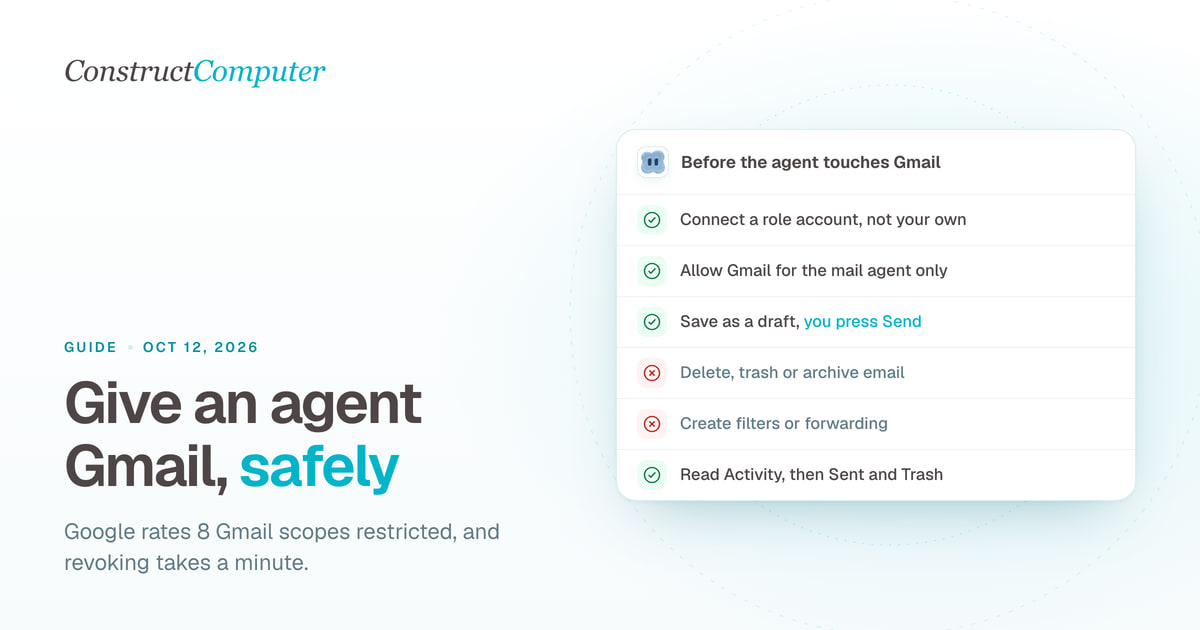
How to Let an AI Agent Use Your Gmail Safely
AI agent Gmail access without the risk: 8 restricted Gmail scopes explained, a separate agent inbox, drafts instead of sends, and a 1-minute revoke.
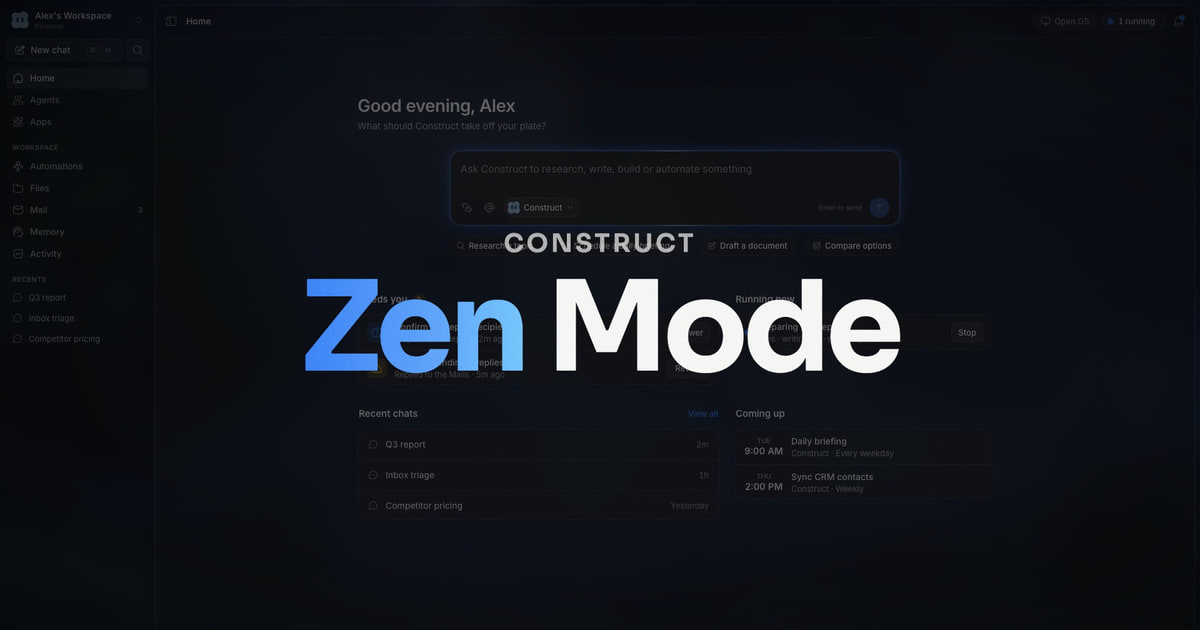
Zen Mode: some days you just want it done
Zen Mode is a chat-first way into Construct's AI computer. Ask once, it works in the background, asks when it needs you, and runs on your phone.
- product
- ai-agent
- ai-employee
- zen-mode

What is an AI agent with its own computer?
An AI agent with its own computer keeps working in a cloud workspace after you close your laptop. How it works, the risks, and who offers one, from $9 a month.
- ai-agent
- always-on-agent
- ai-employee
- product

Nobody merges an email
Agents made work cheap to produce and no cheaper to check. Why software absorbed the flood, why the rest of the business did not, and the five things that make agent work checkable.

