AI Workflow Automation

Nischal · Author
Writes about Construct, AI agents, and building useful software.
Published · Updated · @naik_nischal
On this page11 sections · 7 min read
- Why do this in Construct?
- From one good run to a reusable procedure
- A worked example: the Monday competitor digest
- Run now or put it on the Calendar
- Use the right execution surface
- Inspect every run
- Before you start: designing for linear runs
- Already using Zapier or Make? Add Construct in 15 minutes
- When might a trigger-action tool still fit?
- Start your first workflow
- Related resources
Construct turns a job that worked once into a saved workflow that runs from its Calendar, server-side with your laptop closed, from $9 a month with 3 scheduled tasks on Lite. Trigger-action tools need every step wired in advance, so the moment a job needs research, a rewritten summary, or a page that changed its layout, the recipe stops and a person finishes it by hand.
For founders and small teams, Construct is the better way to automate recurring knowledge work. An agent step handles the parts that need judgment, connected-app actions and notifications handle the rest, and every run leaves files and history you can open. You build the workflow from a run that already succeeded, so it is a record of working steps rather than a guess.
Why do this in Construct?
- Encode after it works. Do the job once in chat, confirm the output, then save the steps as a workflow.
- Agent steps where rules break. An agent step reads the situation and decides what to do, so a changed page or an odd input does not stop the run.
- Every surface in one procedure. Connected-app actions, web research, a live browser, a sandbox terminal, workspace files, and its own email address.
- Runs with your laptop closed. Calendar schedules run server-side: 3 scheduled tasks on Lite, 10 on Starter, 50 on Pro.
- Published versions stay put. Editing a workflow does not silently rewrite a run that already started.
- Anyone on the team can run it. Team workspaces have Owner, Admin, and Member roles and no member limit, so coverage no longer depends on the person who wrote the steps.
From one good run to a reusable procedure
AI workflow automation is useful when a procedure contains research, judgment, writing, or tool use that cannot be reduced to a fixed data mapping. Construct combines durable workflow steps with an agent that handles those less predictable parts.
A workflow can include agent work, connected-app actions, and in-app notifications. Published versions are preserved so a future edit does not silently change a run that already started. Run history makes the procedure easier to inspect and improve over time.
The sequence that works is to do the job once conversationally, confirm the output is right, and only then encode it. A workflow written before the job has ever succeeded is a guess about the steps. A workflow written afterwards is a record of steps already known to produce the result you wanted.
A worked example: the Monday competitor digest
Consider a recurring task: every Monday, check five competitors' pricing pages, note anything that changed since last week, and save a dated summary for the team.
Run it once. Ask Construct to gather the current pricing for each competitor and summarize it. It uses web search and fetch for public pages, and a live browser run for any page that needs interaction. You review the output and correct the framing.
Encode it. Save the procedure as a workflow: an agent step that gathers and compares pricing and saves a dated summary to Files, and a notification step so you see the run even when nobody is watching the workspace.
Schedule it. Add it to Construct's Calendar as a recurring Monday job. The scheduler runs it server-side and reconciles missed or delayed work rather than depending on an open browser tab.
Inspect it. Each run leaves step results, retry information, and Activity summaries. Agent steps link back to their chat sessions, so a week where the summary looked wrong can be opened and read rather than guessed at.
The durable output is a versioned procedure, a dated summary each week, and a run history that makes the procedure improvable. When a competitor redesigns a pricing page and the step starts returning less useful results, the run history is where that shows up.
Silent product demo: Construct building and running a reusable workflow in the product interface, with agent steps, connected apps, and notifications.

Run now or put it on the Calendar
Construct's Calendar is a scheduler for agent work and workflows. Create a one-time job, define a recurring schedule, run it immediately, or cancel it from the same workspace. Scheduled runs happen server-side, so they do not depend on an open browser tab or your laptop being on.
This makes recurring operating work practical: weekly market research, an inbox summary, a customer follow-up list, or a report assembled from several connected systems. Google Calendar can be connected as an external app, but Construct's native Calendar controls when agent jobs run.
Workflow runs start on demand or from the Calendar. For a workflow that should react to incoming mail, schedule an inbox check at the interval you choose; the agent reads what arrived since the last run and handles it.
Use the right execution surface
Each step can use the surface that fits the job. Structured app actions are best for reliable updates. Web search and fetch handle public research. A live browser covers interactive sites, including logins completed during that run. The sandbox terminal processes files, runs scripts, and generates artifacts, with files saved under the workspace persisting after the run.
| Step needs | Best surface | Where the result lives |
|---|---|---|
| Update a record in a business app | Connected-app action | In that app |
| Research a public topic | Web search and fetch | Saved files or memory |
| Use a site that needs interaction | Live browser run | Files the step saves during the run |
| Transform a file or run a script | Sandbox terminal | Workspace files |
| Tell someone the run happened | In-app notification | In the workspace |
The right-hand column matters more than it first appears. Live browser runs and shell state exist for the duration of the run, so anything a later step or a later week depends on should be written to workspace files while the run is in progress. Construct saves finished work as it goes, so a run that stops at step 30 still leaves steps 1 to 29 behind.
- Collect sources and create a cited brief
- Read messages and update a connected system
- Process a file and save the transformed output
- Create an in-app notification, or post through a connected app
Inspect every run
Workflow automation should be debuggable. Construct keeps run state, step results, retry information, and Activity summaries. You can open resulting files and review connected-app actions; agent steps also link to their chat sessions, and the agent can ask for missing information during interactive work.
Construct's workflows do not pause for approval yet, so for a workflow that posts publicly, emails customers, or updates shared records, have it save drafts for a person to send, and run it manually a few times before it goes on a schedule. Reviewing the first several runs is the cheapest way to catch a step that behaves differently than intended.
Before you start: designing for linear runs
Construct workflows run as a straight sequence of steps, which keeps them readable: a sequence you can walk, not a graph you have to debug. A few patterns follow.
- Conditional work belongs inside an agent step. The agent reads the situation and decides what to do; the workflow itself does not fork.
- Multi-stage procedures can be split into separate workflows scheduled at different times, with workspace files carrying state between them.
- Approval-gated work works best as an on-demand workflow that a person starts after reviewing, or as a scheduled run that saves drafts.
- Jobs that run once are quicker to assign in chat than to encode, and a procedure still changing weekly is worth running in chat until its shape settles.
Already using Zapier or Make? Add Construct in 15 minutes
Keep your existing automations. Move the one that keeps needing a person to finish it.
- Start on Lite for $9, or take the 7-day Pro trial for longer runs and more scheduled tasks.
- Describe the outcome in a Construct chat, pasting in the steps and rules from your current flow.
- Connect the apps the job needs from the integration catalog.
- Run it once and check the result in Files.
- Save it as a workflow and put it on the Calendar.
There is no import from other automation tools: the job description and the saved workflow replace the flow. The Construct vs Zapier comparison covers where each model fits, and AI agent vs Zapier automation walks the same workflow built both ways.
When might a trigger-action tool still fit?
- Purely deterministic, high-volume mappings with no judgment step.
- Work that must react within seconds of an event.
- A flow that needs built-in branching, delays, or fan-out today.
For a procedure that is stable, repeated, and needs enough judgment that a fixed mapping would be brittle, Construct is the better fit.
Start your first workflow
Choose Construct for recurring work that needs judgment. It starts at $9 a month, builds the workflow from a run that already worked, runs it server-side on a schedule, and keeps every result where your team can open it.
Give Construct the Monday competitor digest: list the five pricing pages, ask for a dated summary of what changed, check the first result, save it as a workflow, and put it on the Calendar, where it uses one of Lite's 3 scheduled tasks. Start on Lite at $9, or try Pro free for seven days.
Related resources
Frequently asked questions
- What is an AI workflow in Construct?
- A reusable procedure combining agent steps, connected-app actions, and notifications, saved from a run that already worked. Anyone on the team can run it on demand, or it can run from the native Calendar, server-side with your laptop closed. Lite includes 3 scheduled tasks for $9 a month.
- Is Construct a good alternative to Zapier or Make for recurring work?
- For recurring work that needs research, judgment, or a site with no integration, yes. An agent step handles the parts a fixed mapping cannot, and every run leaves files and history. Keep your existing automations for deterministic, high-volume mappings and add Construct alongside.
- Can workflows include branching or approval steps?
- Not yet. Workflows run as a straight sequence, so put conditional work inside an agent step, split multi-stage procedures into separate scheduled workflows, and have customer-facing workflows save drafts for a person to send.
- What can a workflow act on?
- Connected business apps, web search and fetch, live browser runs, the sandbox terminal, workspace files, the agent's own email, and in-app notifications, so a single procedure can span the tools a process actually touches.
- When does a trigger-action tool still make sense?
- For purely deterministic, high-volume mappings with no judgment step, work that must react within seconds of an event, or a flow that needs built-in branching, delays, or fan-out today.
Keep reading
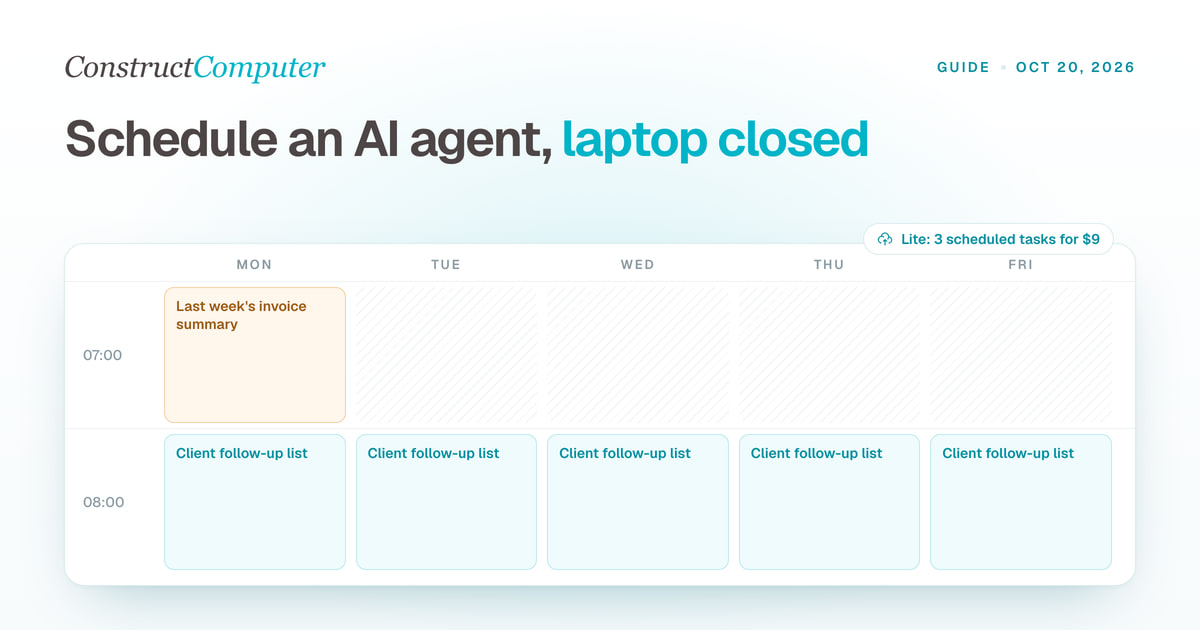
How to Run an AI Agent on a Schedule With Your Laptop Closed
Run AI agent scheduled tasks in the cloud with your laptop shut. Construct includes 3, 10, or 50 by plan, from $9 a month. Steps, prompts, and limits.
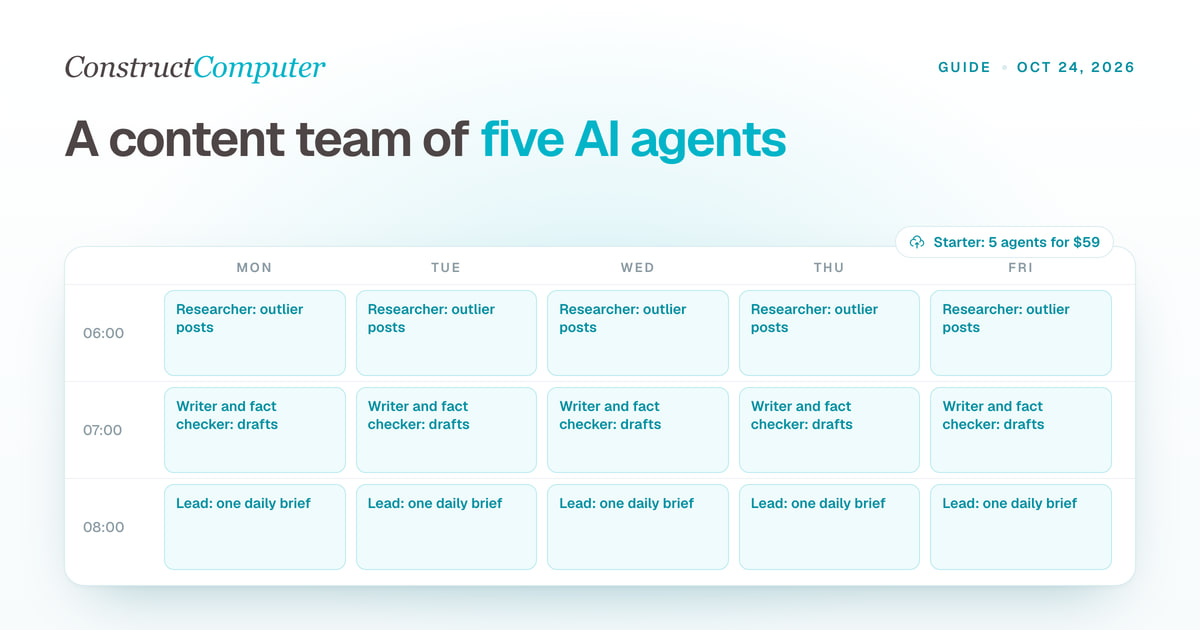
AI agents for content creation: build a content team in Construct
Set up a team of AI agents for content creation: a lead, a researcher, a writer, a fact checker and an analyst, with role prompts, schedules and a daily brief.
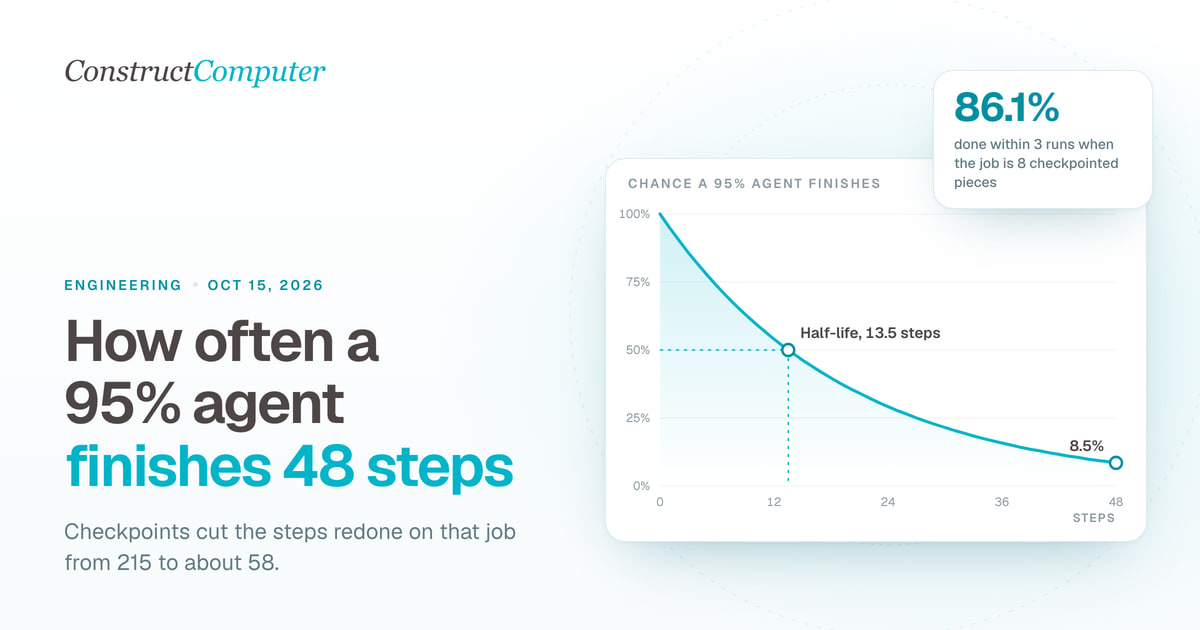
Agent reliability calculator: how many steps will your agent finish?
AI agent reliability calculator: a 95% reliable agent finishes a 48-step job in one run 8.5% of the time. See retries, half-life, and what checkpoints fix.

Your agent has a half-life
Why AI agents keep failing on long multi-step jobs: a 95% reliable agent finishes 48 steps 8.5% of the time. The fix is a resumable run, not a better model.

