
Why AI agents fail on long tasks: your agent has a half-life
A 95% reliable agent finishes a 48-step job 8.5% of the time. Why long runs fail, the math for retries and checkpoints, and how to make a job resumable.
 Ankush Singh
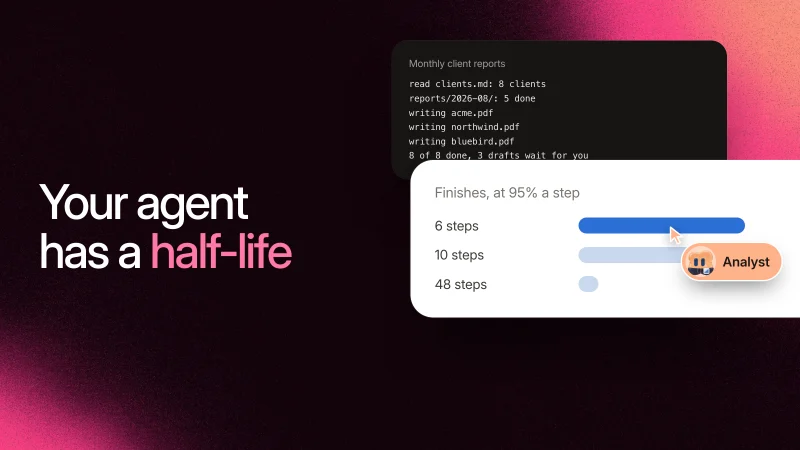
An AI agent that gets 95% of its steps right finishes a ten-step job about 60% of the time and a 48-step job about 8.5% of the time, and no step has to get worse for that to happen. Per-step success rates multiply: 0.95 to the tenth power is 0.60, and to the 48th it is 0.085. If your agent keeps failing partway through a long job, the length of the run is usually the cause, and the fix that works today is to cut the job into pieces that save their work and can be resumed.
Reliability that looks excellent per step is mediocre per job, and most people don’t feel it until they schedule something and walk away.
Why your agent keeps failing on long tasks
The tempting explanation is that long tasks are harder tasks: more ambiguity, more chances to misread the goal, more compounding confusion.
The evidence points elsewhere. In “Is there a half-life for the success rates of AI agents?”, Toby Ord shows that agent performance across task lengths is explained by a very simple model: “a constant rate of failing during each minute a human would take to do the task”, which implies a success rate that falls exponentially with the length of the task (Ord, arXiv:2505.05115). The hazard is flat and it ticks the whole time the job runs.
Physicists have a name for that shape. A constant decay rate λ gives N(t) = N₀·e^(-λt), and the half-life is t½ = ln(2) / λ, the time by which half of a sample is gone. Ord’s result gives every agent a half-life too: the task length at which its chance of success falls to 50%. Longer tasks fail, in Ord’s framing, because they contain more subtasks, and failing any one of them fails the whole thing.
That reframes the problem. If failure were about difficulty, you would fix it with a smarter model. If failure is a rate per unit of exposure, you fix it by reducing exposure: shorter runs, each of which has less time to fail. Those are two different engineering programs, and most teams are running the first one.
Why multi-step agent workflows fail: 48 steps, 8.5% success
Ten steps is a toy. Real recurring business work is longer, because it loops.
Take monthly client reporting at a small agency. Eight clients, and for each one the agent pulls analytics, pulls ad spend, pulls the CRM’s deal movement, writes the summary, renders it into the client’s template and emails it. That is six steps, eight times, for 48 steps.
| Per-step reliability | One 48-step run finishes |
|---|---|
| 99% | 62% |
| 95% | 8.5% |
| 90% | 0.6% |
A 95% agent, which is a capable agent, completes that job start to finish about one time in twelve. And the failure mode is the ugly one: it dies at client six, having already emailed five reports, and you can’t tell what state anything is in without reading the whole transcript.
So people conclude agents don’t work for real operations. What doesn’t work is running 48 steps as one uninterrupted bet.
Will a better model fix agent reliability?
Models are getting better at long tasks. METR measures the 50% time horizon, the length of task (in human expert time) at which an agent is predicted to succeed half the time, and in March 2025 it reported that horizon doubling roughly every seven months over six years (METR). METR has since marked parts of that post, the seven-month figure among them, as out of date, and its time horizons page says it is no longer actively updated (last updated September 8, 2026).
The progress is real, and it is still a poor thing to plan a business process around. The horizon is defined at 50% reliability, which is a coin flip, and a doubling curve tells you nothing about next Tuesday’s client reports. Gartner predicts that over 40% of agentic AI projects will be canceled by the end of 2027, citing escalating costs, unclear business value and inadequate risk controls (Gartner, June 2025). A demo that worked once and then failed most weeks on a schedule is an easy way into that number.
A model one tier better moves your per-step rate a few points and leaves the exponent alone. Shortening the run changes the exponent, and you can do it now.
How to fix an agent that fails partway: cut the job at the seams
Split those 48 steps into eight independent six-step runs, one per client, and the arithmetic turns around.
At 95% per step, one client’s six-step run finishes 73.5% of the time. So a pass over eight clients lands about six of them, and the two that failed are named, isolated and retryable. Run the retry and about 93% of the work is done, with the gap being two specific clients you can look at instead of one opaque dead job.
The model, the per-step reliability and the total work all stay the same. The only change is where a run is allowed to stop and be resumed. You haven’t lowered λ; you have shortened how long any one run has to survive it.
The catch is that this only works if state survives between the pieces. A six-step run that has to rebuild its own context from scratch, re-derive the client’s template and re-fetch what it already fetched has been shortened and then padded back out. Checkpointing is only cheap when the checkpoint is written somewhere durable: a file on disk that says this piece already finished, rather than a memory that evaporates when the turn ends. That is the practical argument for giving an agent a computer of its own instead of only a context window.
The math: half-life, retries and checkpoints
Everything here comes from one assumption: each step succeeds independently with the same probability p. For a job of n steps cut into k pieces of s steps each:
One run finishes the whole job:             P = p^n
Runs needed when every failure starts over: E[runs] = 1 / p^n
The agent's half-life in steps:             n_half = ln 2 / (-ln p)

With resumable pieces, each piece succeeds with q = p^s.
Pieces that don't depend on each other, done within R runs:
                                            P = (1 - (1 - q)^R)^k
Pieces that each need the one before, average runs:
                                            E[runs] = 1 + k * (1/q - 1)
At 95% per step the half-life is about 13.5 steps. At 99% it is about 69, and at 90% about 6.6. If one uninterrupted stretch of your job is much longer than your agent’s half-life, most runs of that stretch will fail, and the fix is a shorter stretch rather than a longer prompt.
Here is the 48-step reporting job at 95% per step, with three runs to get it done:
| Setup | Finishes in one run | Work done after the first run | Average runs | Steps executed, redone work included | Done within 3 runs |
|---|---|---|---|---|---|
| One piece, start over on failure | 8.5% | 8.5% | 11.7 | 215 | 23.5% |
| 8 pieces, a failure stops the run | 8.5% | 31.7% | 3.9 | 57.7 | 48.1% |
| 8 pieces, skip a failure and carry on | 8.5% | 73.5% | 2.5 | 57.7 | 86.1% |
The first column never moves: checkpoints don’t change the chance that one run finishes everything. What they change is what a failure costs. The steps executed fall from 215 to under 58 the moment finished work is saved, because a retry only redoes the piece that failed. And the shape of the job matters as much as the checkpoints: if a failure on one client doesn’t have to stop the others, the job converges in about two and a half runs instead of four.
At 99% the picture softens: one uninterrupted run finishes 61.7% of the time and the job averages 1.6 runs even without checkpoints. At 90% it collapses: 0.6% in one run and about 157 runs on average if every failure starts over, against about 4.1 runs with eight independent pieces.
To find your own p, run the job by hand five to ten times while you watch, count the steps and the failures the agent didn’t recover from, and divide. Ten runs with 400 steps and 16 unrecovered failures is about 96% per step. If the same step fails every time, that is a systematic failure to fix, and no rate describes it.
Why real agents fail differently from the math
Treat the table as a planning floor. Real agents break the independence assumption in ways that matter:
- Failures correlate. If a step fails because a login expired or a page layout changed, the retry fails the same way, and no number of retries helps until someone fixes the cause.
- Steps are unequal. A step that copies a value is far more reliable than one that decides which clients count as at risk, and one weak step dominates the product. Give it its own piece.
- Agents recover from some errors inside a run. The p you plug in should count only the failures the agent didn’t recover from.
- Some failures are silent. An agent that confidently writes the wrong number into a report hasn’t failed by this math, and it is the more expensive case. Nobody merges an email is about that check.
- Checkpoints cost steps. Each piece reads its state back in, and each added step can fail, so pieces that are mostly reading back are too small.
How Construct runs the same job
Each Construct workspace has its own computer, with files that outlive the chat, a memory that carries what you’ve taught it across chats, and workflows you can run by hand, on a schedule, or when an email or a file arrives. Those pieces turn the reporting job from one long bet into a job that converges.
| Piece | What it is in Construct | Why it matters to the math |
|---|---|---|
| The client list | A file in Files, clients.md, that the agent reads at the start of every run |
The run’s scope is data on disk, not something rebuilt from a prompt |
| The finished work | One report per client in a reports/2026-08/ folder, saved as each one finishes |
Every finished piece outlives the run that made it |
| The instruction | “For each client in clients.md with no report in reports/2026-08/, write one and draft the email” |
The job describes the remaining work, so a rerun is a retry rather than a duplicate |
| Standing preferences | Memory: the template a given client wants, the metrics they care about | Piece six doesn’t re-derive what piece one already learned |
| The retry | The workflow’s schedule, or a run by hand when you want it sooner | The clients that failed get picked up next pass with no bookkeeping |
| The diagnosis | The workflow’s run history: open a run to see what every step did | You find the step that broke without rereading a transcript |
| The send | The email step asks before it sends, every time or once a run, as you choose | A retry can’t send a report twice without you seeing it |
The important row is the instruction. Because it is scoped to clients without a report on disk, a run that dies at client six needs no unwinding. The next run reads the folder, sees five reports and works on the remaining three.
The schedule interval is your retry cadence, so a job that must finish within the hour needs a run by hand rather than patience. Each run reports what it did, so you know which pass to wait for. How our agents get computers we mostly don’t pay for covers the infrastructure that keeps a per-workspace computer cheap enough to leave between runs.
A checklist for building a resumable agent job
The pattern works for anything shaped as “for each X, do a few things”.
- Find the loop. Almost every recurring operations job has one: per client, per invoice, per candidate, per repo. Cut there first, because that cut turns one long bet into many short ones.
- Make each piece leave an artifact a later run can check for: a file, a CRM record, a draft. If a piece leaves nothing behind, you can’t tell a retry from a duplicate.
- Make pieces skip finished work. “Write the report for any client that doesn’t already have one dated this month” is resumable, and “write the reports” isn’t. That one line is usually the difference between a job you can schedule and a job you have to babysit.
- Put the judgment step in its own piece. Judgment steps have a lower per-step success rate than mechanical ones, so isolating them means a bad call costs that piece instead of the run.
- Run the job by hand several times before you schedule it, and watch for the weak step. You won’t guess it correctly in advance.
- When something fails, open the run and find the step, then fix its cause if it fails the same way twice.
Most people write agent instructions as a description of the work. The instructions that survive scheduling describe the work that remains.
What checkpointing does not fix
Checkpointing lowers the cost of failure and leaves the failure rate where it was. You still have the same λ; you just stop staking the whole job on one continuous run.
If your steps are order-dependent all the way through, with no natural loop and no safe stopping point, there is no seam to cut and you are back to one long bet. If a step has an irreversible effect outside the workspace (a payment, a public post, a message to a customer), a retry costs something and has to check before it acts. In Construct, a workflow step that sends or changes something asks you first, every time or once a run, so a scheduled run waits for your approval at that step and a retry can’t send anything you haven’t seen.
Context that has to cross a seam belongs in a file, or in memory by saying “remember this”. Don’t assume it survives because it appeared once in a chat.
And if the work is deterministic, the same trigger and the same transformation every time with no judgment in the middle, a rule-based automation tool will do it more cheaply and more predictably than any agent. AI agent vs Zapier lays out where that line falls.
Ask this instead of “which model should I use”
“Which model should I use” is the question everyone asks, and it is rarely the binding constraint. A better model nudges p. Restructuring a 48-step run into eight 6-step runs changes the exponent, which is where the larger gain is.
Ask instead: when this job fails at step thirty, what is left on disk, and what does the retry have to redo? If the answers are “nothing” and “all of it”, the model isn’t your problem, and the fix is a workspace that outlives the run. AI workflow automation covers how saved steps and schedules fit together, and AI agent memory covers what carries from one run to the next and how to correct it.
More from the blog


Hand Construct its first job.
Start freeOpen Construct